
Tree Climbing Lions in Ishasha Sector
I had seen lions before, or at least, I thought I had.
In documentaries, on screens, in photographs that captured their power and dominance across the African plains. But nothing quite prepared me for the moment I would encounter them in a way that felt almost unreal, resting quietly in the branches of a tree.
This experience unfolded deep in the southern sector of Queen Elizabeth National Park, in a region known as Ishasha. By the time I reached this part of Uganda, I had already experienced game drives, boat cruises, and forest treks. Yet, nothing had quite captured my imagination the way the idea of tree-climbing lions did.
I had heard about them before arriving. My guide mentioned it casually, as if it were just another highlight of the park. But to me, it sounded extraordinary, almost mythical.
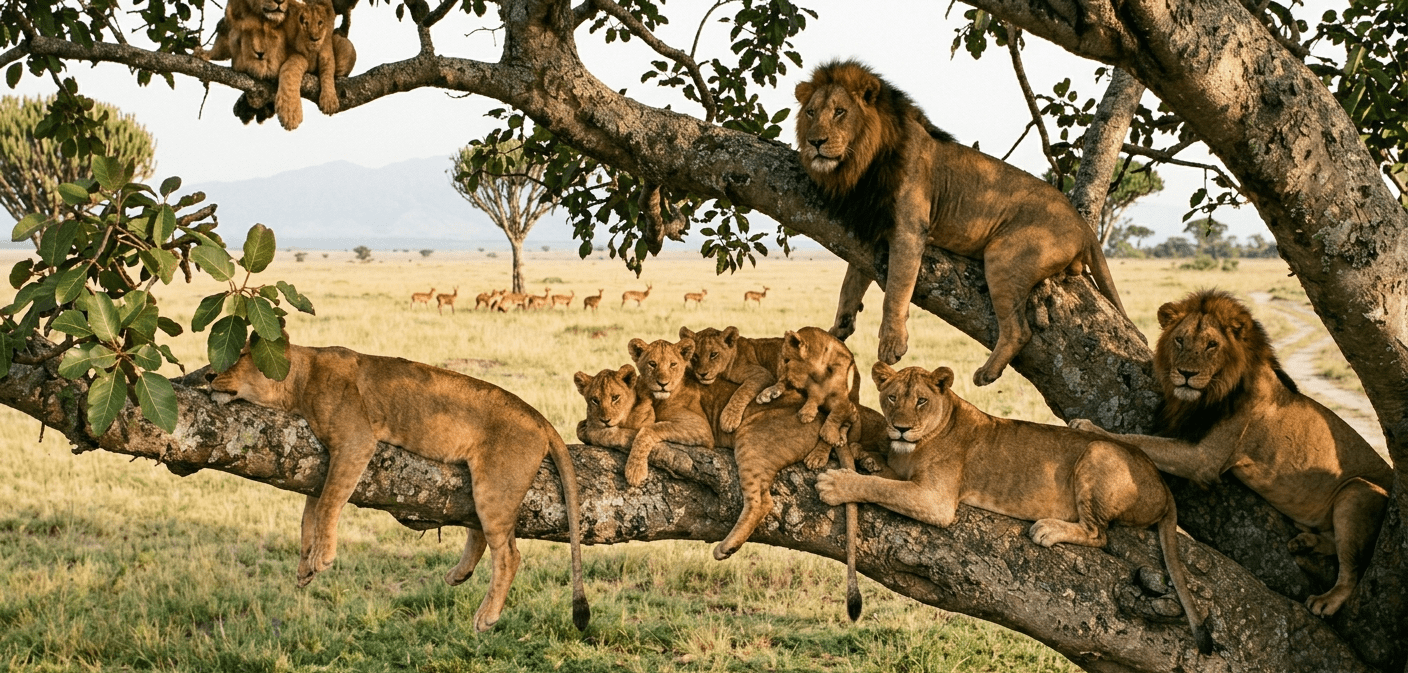
Lions that climb trees?
I wasn’t sure what to expect.
The Journey into Ishasha
The drive toward Ishasha felt different from the rest of the park.
As we left the more central areas of Queen Elizabeth National Park, the landscape gradually opened into vast, quiet plains. The road became less traveled, the environment more remote, and the sense of wilderness more pronounced.
There was a stillness in the air that I couldn’t quite describe. It wasn’t silence, it was something deeper, something that made you feel like you were entering a space where nature existed on its own terms.
Our vehicle moved slowly, scanning the horizon. My guide remained alert, his eyes constantly searching for movement, for shapes that might reveal themselves as something extraordinary.
And then, he slowed down.
“There,” he said calmly.
I followed his gaze.
The First Sight of Tree-Climbing Lions
At first, I didn’t see them.
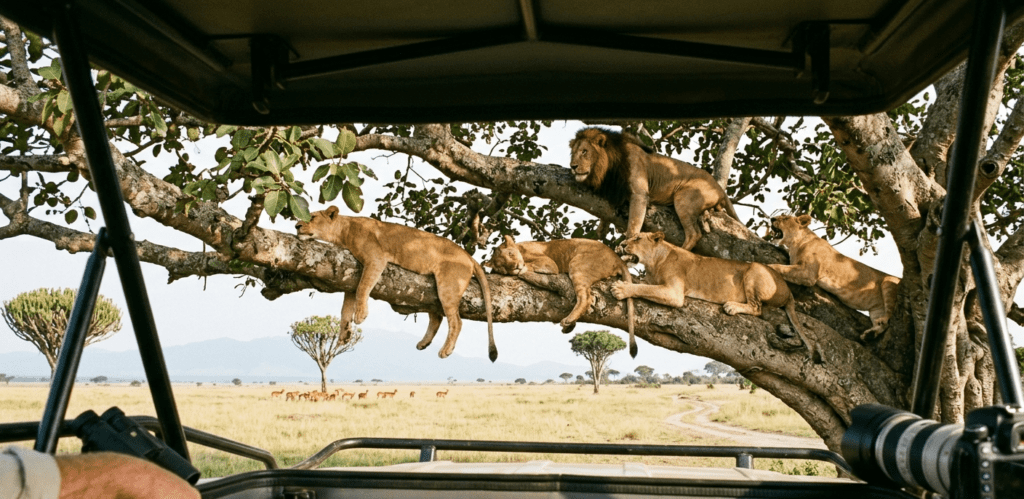
The tree stood tall and wide, its branches spreading outward like arms reaching into the sky. It looked like any other tree in the savannah—until I looked more carefully.
And then, slowly, I noticed it.
A shape resting across one of the thick branches.
A lion.
It was lying comfortably, draped across the tree as if it belonged there. Its body was relaxed, its posture calm, almost indifferent to the world below.
I leaned forward, trying to confirm what I was seeing. And as my eyes adjusted, I realized there was more than one.
Another lion.
And then another.
Three lions, all resting in the same tree, each occupying a different branch, each seemingly at ease in their elevated position.
It was one of those moments where your mind struggles to process what your eyes are witnessing.
Lions in trees.
Real, living lions.
Why Lions Climb Trees in Ishasha
As I observed them, I asked my guide why these lions behaved this way. His explanation added depth to what I was seeing.
In the Ishasha sector of Queen Elizabeth National Park, lions climb trees for several reasons. During the heat of the day, the ground can become warm and uncomfortable. By moving into the trees, they find cooler air and a more comfortable resting position.
Additionally, climbing trees may help them avoid insects and get a better vantage point of their surroundings.
But even with this explanation, the behavior still felt extraordinary. Lions are typically associated with strength on the ground, not agility in trees.
Yet here they were, perfectly adapted to their environment.
Watching in Silence
We turned off the engine and sat quietly.
There was no need for words.
The lions remained still, occasionally shifting their positions slightly, but mostly resting. One of them opened its eyes briefly, scanning the surroundings below before settling back into its relaxed state.
I found myself watching without distraction, fully immersed in the moment.
There was something deeply calming about the scene. Despite their reputation as powerful predators, the lions appeared peaceful, almost detached from the intensity they are known for.
It reminded me that wildlife doesn’t always behave the way we expect. Nature has its own rhythms, its own patterns, and its own surprises.
The Landscape of Ishasha
As I continued to observe the lions, I took in the surrounding landscape.
The Ishasha sector is quieter compared to other parts of Queen Elizabeth National Park. The open plains stretch far into the distance, dotted with acacia trees and occasional clusters of vegetation.
The remoteness of the area adds to its charm.
Unlike busier safari routes, Ishasha feels untouched, almost hidden. It is a place where encounters like this feel rare and personal, rather than crowded or rushed.
Being here gave me a sense of exclusivity, like I was witnessing something not everyone gets to experience.
Time Slows Down
As the minutes passed, I realized something important: time felt different here.
There was no urgency, no schedule to follow, no movement that needed to happen immediately. Just the quiet presence of wildlife and the steady passage of time.
I stayed there longer than I expected, simply watching.
Each lion remained in place, occasionally adjusting its position, stretching slightly, or flicking its tail. These subtle movements were enough to keep the scene alive, yet calm.
It was a reminder that safari experiences are not always about constant action. Sometimes, the most meaningful moments come from stillness.
The Role of the Guide
Throughout the experience, my guide played a crucial role.
His ability to spot the lions from a distance, his knowledge of their behavior, and his understanding of the landscape made the entire encounter possible.
He explained that sightings in Ishasha are never guaranteed. The lions move freely, and locating them requires patience, experience, and familiarity with the terrain.
Without his guidance, I might have driven past the very tree where the lions were resting.
This reinforced something I had already begun to understand during my travels in Uganda—that guides are not just facilitators, but essential interpreters of the natural world.
A Rare Behavior, A Unique Experience
Tree-climbing lions are not commonly found across Africa. Their presence in Ishasha makes this region particularly special.
As I continued to observe them, I thought about how unique this behavior truly is. It is not something learned overnight—it is a trait that has developed over time, shaped by environment and necessity.
Seeing them in person felt like witnessing a rare adaptation in action.
It wasn’t just about the visual experience—it was about understanding that nature constantly evolves in ways that are both subtle and remarkable.
The Emotional Impact of the Encounter
There are certain moments in travel that stay with you long after they are over.
This was one of them.
Watching tree-climbing lions in Ishasha was not just a highlight of my safari—it was a moment of connection. A reminder of the beauty of the natural world and the importance of preserving it.
I felt a sense of gratitude for being there, for having the opportunity to witness something so unique in its natural environment.
It wasn’t just about seeing lions.
It was about experiencing a part of the world that still operates in its purest form.
Leaving Ishasha
Eventually, it was time to move on.
As we drove away from the tree, I looked back one more time. The lions were still there, resting in their elevated positions, undisturbed by our presence.
The tree slowly disappeared from view as we continued along the road, but the memory remained vivid.
It wasn’t just a sighting, it was an experience that left a lasting impression.
Lastly My journey through Ishasha in Queen Elizabeth National Park reminded me that safaris are not just about checking off sightings—they are about moments that challenge your expectations and expand your understanding of wildlife.
Tree-climbing lions are one of those rare phenomena that make Uganda’s safari experiences truly distinctive.
They represent adaptation, survival, and the quiet intelligence of nature.
And for me, they represent one of the most memorable encounters I had during my travels across Uganda.
Plan Your Safari with Feather Trail Safaris
If you are planning a safari and want to experience the unique tree-climbing lions of Ishasha, Feather Trail Safaris can help you design a journey that includes this remarkable destination.
With expert guides, well-planned itineraries, and deep local knowledge, your experience in Uganda can be both seamless and unforgettable.
Because sometimes, the most extraordinary moments in travel are the ones you never expect, like finding lions resting quietly in the branches of a tree.