
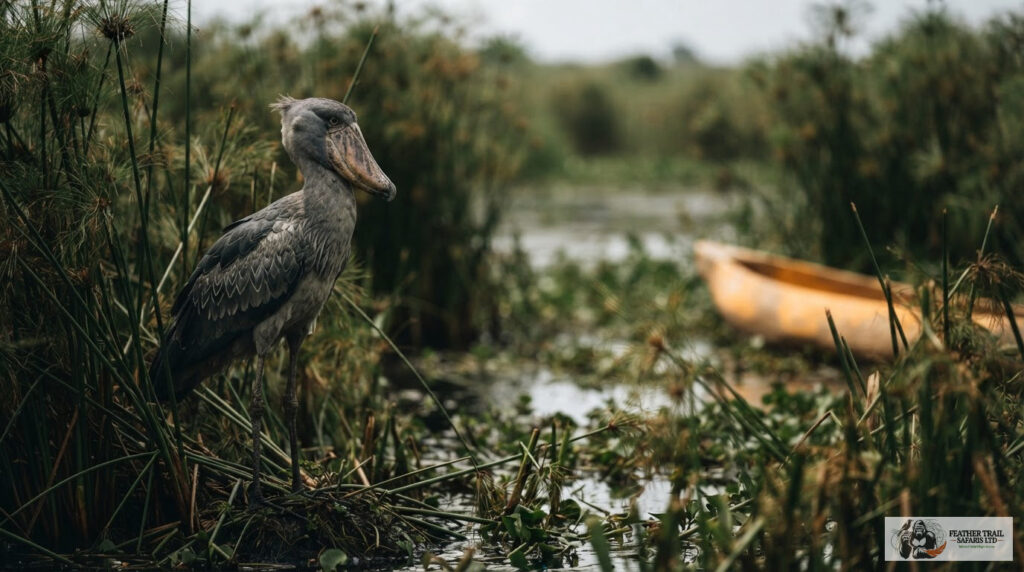
Key Takeaways for Your Shoebill Safari
- Top Location: Mabamba Swamp is the most accessible site, located just an hour from Entebbe.
- Best Timing: Aim for 6:00 AM starts; shoebills are most active and visible during the cooler early morning hours.
- Method of Travel: Most sightings occur via motorized or traditional canoe trips through narrow papyrus channels.
- Conservation Status: The shoebill is classified as Vulnerable, making responsible tourism essential for habitat protection.
- What to Bring: Binoculars and a telephoto lens (300mm+) are vital, as birds often stand at a distance within the reeds.
If you are planning a mountain gorilla trekking holiday or a wider East African adventure, the shoebill stork (Balaeniceps rex) is likely at the top of your wildlife bucket list.
Known for its prehistoric appearance and a massive, shoe-shaped bill that looks like it belongs in the Cretaceous period, this bird is one of Africa’s most enigmatic species.
Uganda is globally recognized as the premier destination to find them, housing an estimated population of 1,000 individuals across its diverse wetlands.
A practical guide for travelers looking to explore the “Pearl of Africa” must emphasize that where to see shoebill stork in uganda safari depends largely on your broader itinerary and how much time you can dedicate to the search.
Whether you are seeking a quick day trip from the airport or a deep dive into the national parks, Uganda offers several reliable hotspots. Much of the country’s best scenery unfolds in these marshy regions where the Nile meets the Great Lakes.
Understanding the logistical trade-offs between different sites—such as travel time, permit costs, and sighting probabilities—will help you maximize your chances of an encounter. Below is a detailed comparison of the primary locations where you can witness this “dinosaur bird” in its natural forest habitat and wetland strongholds.
| Location | Best For | Travel Method | Likelihood of Sighting |
|---|---|---|---|
| Mabamba Swamp | Day trips from Entebbe | Motorized Canoe | Very High |
| Albert Delta (Murchison) | Big Game Safari combos | Safari Boat | High |
| Ziwa Rhino Sanctuary | Overnight stays | Small Canoe | Excellent |
| Lake Mburo | General birding | Boat Safari | Moderate |
1. Mabamba Swamp: The Most Accessible Hotspot
Mabamba Swamp is the premier destination for travelers wanting to see the shoebill stork without venturing deep into the interior of the country. Located on the northern shores of Lake Victoria, approximately 12 kilometers west of Entebbe, this Ramsar-recognized wetland provides a high probability of sightings within a single morning excursion.
The experience at Mabamba typically involves a mabamba wetland shoebill tour cost that covers boat rental and a local birding guide. You will navigate through narrow channels of papyrus and water lilies in a motorized wooden canoe. The local community has transitioned from hunting these birds to protecting them, serving as expert guides who track the birds’ movements daily. Because the swamp covers over 2,400 hectares, having a guide who knows the specific territories of individual birds is essential.
Most uganda birding safari itineraries start here because of the proximity to Entebbe International Airport. You can reach the swamp via a 45-minute boat ride from the Nakiwogo landing site or by a 1.5-hour drive from Entebbe/Kampala. Arriving by boat is often preferred for birding. You can spot kingfishers and jacanas before reaching the shoebill’s grounds.
Best for: Short-stay travelers, photographers, and those starting or ending their safari in Entebbe.
2. The Albert Delta in Murchison Falls National Park
The Albert Delta, where the Victoria Nile flows into Lake Albert, is the most reliable location for shoebill sightings within a traditional national park setting. This area offers a unique opportunity to view the bird alongside iconic African megafauna like elephants, hippos, and giant Nile crocodiles during a morning boat safari.
In Murchison Falls National Park, the shoebill is often found along the banks where the water slows and papyrus becomes dense. Unlike the narrow channels of Mabamba, the Albert Delta provides wide-open vistas, allowing for sightings of the bird in flight or standing stoically on floating vegetation. The “freeze and seize” hunting strategy of the shoebill is on full display here; they can remain motionless for hours waiting for lungfish to surface in the oxygen-depleted shallows.
Planning this excursion requires booking a specific “delta boat trip” rather than the standard boat cruise to the base of the falls. These trips depart early in the morning and head downstream. It is a fantastic way to integrate the search for the shoebill into a broader Big 5 safari in East Africa, as the delta is also a magnet for lions and leopards during the dry season.
Best for: Travelers who want to combine birding with big game viewing and boat-based safaris.
3. Ziwa Rhino Sanctuary (Lugogo Swamp)
Ziwa Rhino Sanctuary offers one of the most intimate shoebill encounters in Uganda, with a nearly 100% success rate during their dedicated early morning canoe treks. Located in the Lugogo Swamp within the sanctuary, this site is famous for nesting pairs that are carefully monitored by sanctuary rangers.
To participate in a shoebill trek at Ziwa, an overnight stay at the sanctuary’s lodge is mandatory. This is because the activity begins at 6:00 AM, whereas the sanctuary gates do not open to outside visitors until 7:30 AM.
Setting off as the sun rises over the swamp provides not only the best lighting for photography but also the highest activity levels for the birds.
Rangers have recorded up to 11 shoebills in a single trip, making it a statistically superior choice for enthusiasts.
The trek involves a quiet canoe ride through the reeds. Because the sanctuary is a protected area for rhinos, the entire ecosystem is exceptionally well-preserved. This is an ideal stopover between Kampala and Murchison Falls. You can see both the White Rhino and shoebill in 24 hours. The tranquility of the Lugogo Swamp at dawn is a highlight for many Uganda top selling tours.
Best for: Enthusiasts seeking a guaranteed sighting and those already planning a visit to see rhinos.
4. Lake Mburo National Park
Lake Mburo National Park is a hidden gem for birders, offering shoebill sightings along the eastern banks of the lake during boat safaris. While the density of shoebills is lower here than at Mabamba or Ziwa, the park’s accessibility and diverse avian life make it a worthy inclusion for any serious birder.
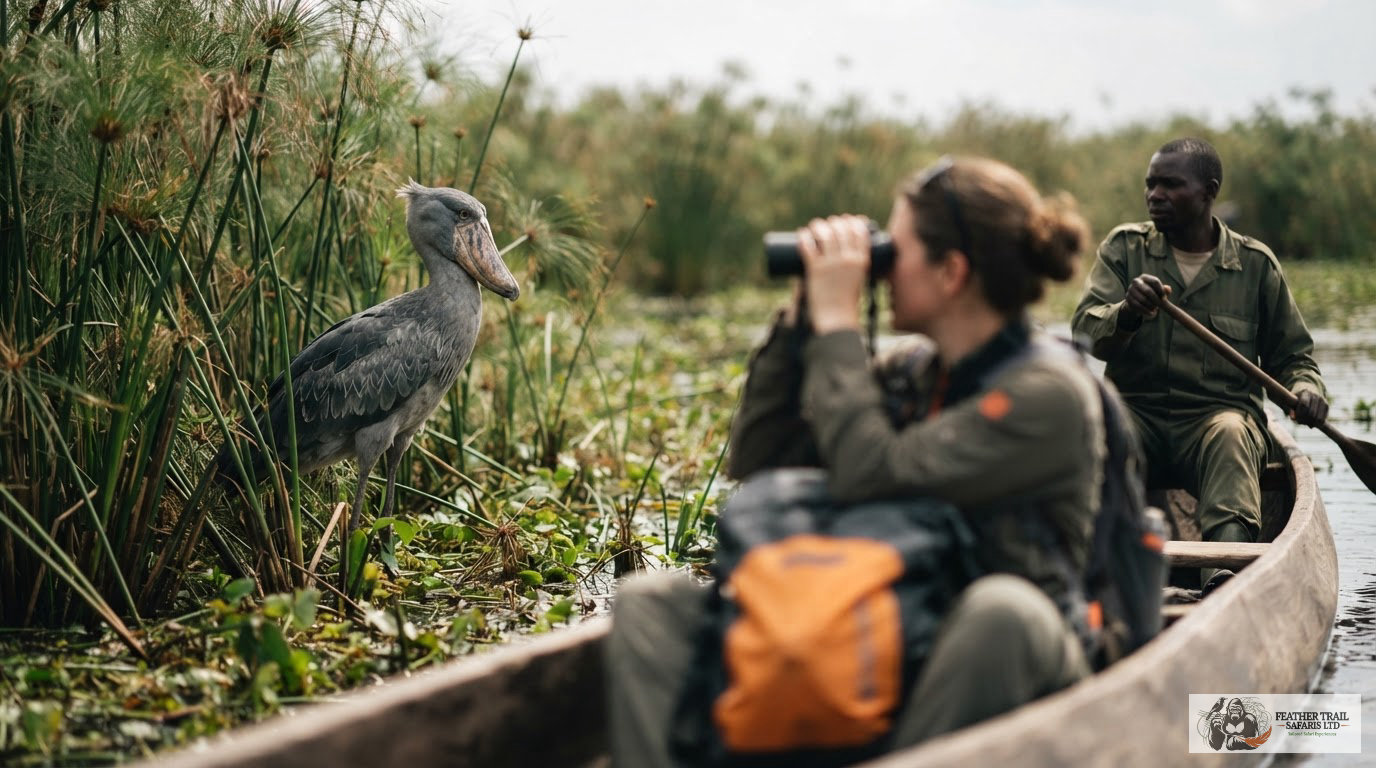
The shoebills in Lake Mburo are typically found in the swampy fringes where the lake meets the papyrus marshes. A boat cruise here is less crowded than in other parks, providing a peaceful environment to search for the bird.
Beyond the shoebill, Lake Mburo is the only place in southern Uganda to see the African Finfoot, another highly sought-after species by ornithologists.
Integrating this into birding safaris in Uganda allows travelers to see a wide variety of acacia-associated birds alongside the wetland specialists.
Logistically, Lake Mburo is the closest savannah park to Kampala, making it an easy addition to a southern circuit that includes Bwindi Impenetrable Forest. Whether you are self-driving or arranging a driver-guide, the park offers well-maintained tracks and reliable boat schedules that can be adjusted to fit a birding-heavy itinerary.
Best for: Travelers on the southern circuit who want to see zebras, impalas, and the African Finfoot alongside the shoebill.
5. Makanaga Swamp Bay
Makanaga Swamp is a quieter, less-trafficked alternative to Mabamba, located on Lake Victoria. The habitat features floating papyrus and water lilies with fewer tourist boats. It is an excellent choice for photographers needing stillness.
Accessing Makanaga usually involves a drive from Kampala or Entebbe toward the Masaka road, followed by a detour to the lake shore. Because it is less “discovered” than Mabamba, the experience feels more raw and adventurous.
The birds here are equally habituated to the presence of local fishermen, allowing for relatively close approaches by canoe.
Travelers should note that shoebill stork facts for travelers hearth africa suggest these birds are solitary; finding them in a quiet location like Makanaga allows you to observe their natural hunting behaviors without the pressure of other tour boats.
During the wet seasons (March to May and October to November), the swamp can be more challenging to navigate, but this is also when many migratory birds are present. If you have extra time in Entebbe, Makanaga is the perfect “plan B” if you want to avoid the busier channels of the more popular Mabamba tours.
Best for: Wildlife photographers and birders who prefer off-the-beaten-path locations with fewer crowds.
6. Semuliki National Park and Wildlife Reserve
Semuliki National Park, situated on the remote western border with the Democratic Republic of Congo, offers shoebill sightings on the southern shores of Lake Albert. This is a location for the truly dedicated birdwatcher, as it requires a journey into one of Uganda’s most biodiverse and ancient forest systems.
The habitat here is distinct from the Lake Victoria swamps, consisting of more extensive wetlands that fringe the forest. Seeing a shoebill here is often part of a broader search for Central African bird species that reach their eastern limit in Semuliki. The park is home to over 440 bird species, including the Nkulengu Rail and several species of hornbill. The logistical challenge of reaching Semuliki means you will likely have the swamp to yourself.
Because the park is a natural forest habitat, the environment is humid and dense. You will need a high-clearance vehicle and an experienced guide to navigate the approach to the lake. Sighting probability is lower than at Ziwa or Mabamba due to the vast terrain. However, the environment is wild and untouched.
Best for: Hardcore birders looking for Central African endemics and remote wilderness experiences.
Essential Tips for Shoebill Tracking
To make the most of your excursion, keep the following logistical and ethical considerations in mind:
- Early Starts: As mentioned, 6:00 AM is the “golden hour.” Shoebills are most likely to be active and standing in the open before the heat of the day forces them into the shade of the papyrus.
- Photography Gear: Bring a lens with at least 400mm reach. While shoebills often allow boats to get within 20–30 meters, they are sensitive to sudden movements. According to the Birdwatching standards on Wikipedia, maintaining a respectful distance is key to ethical wildlife observation.
- Health and Safety: Swamps mean mosquitoes. Wear long sleeves, long pants, and apply insect repellent before boarding the boat. Closed-toe shoes are essential for any walking portions of the trek.
- Booking: It is highly recommended to book your tour through a reputable operator like Feather Trail Safaris to ensure you have a professional birding guide rather than just a boat captain.
“The Shoebill is not actually a stork; it belongs to the order Pelecaniformes, making it more closely related to pelicans. Its prehistoric look is a result of millions of years of specialized evolution for hunting in thick swamp vegetation.”
Conservation and the Future of the Shoebill
The shoebill is currently listed as Vulnerable on the IUCN Red List. With a global population estimated between 3,300 and 8,000 mature individuals, the 1,000 birds found in Uganda represent a critical stronghold for the species. The primary threats are habitat destruction due to agricultural drainage, illegal wildlife trade, and human disturbance near nesting sites.
By visiting sites like the Uganda Wildlife Conservation Education Centre or participating in community-led tours in Mabamba, your tourism dollars provide a direct economic incentive for local residents to protect these wetlands. When a shoebill is worth more alive as a tourism attraction than it is as a hunted resource, the community becomes the bird’s strongest guardian.
Conclusion
The answer depends on what you want from your trip, but for most travelers, Mabamba Swamp and the Albert Delta offer the best balance of accessibility and sighting success.
Whether you are a dedicated ornithologist or a casual nature lover, seeing a shoebill stork is a transformative experience that brings the ancient history of Africa to life. Uganda’s commitment to wetland conservation ensures that these “living fossils” continue to roam the papyrus marshes for generations to come.
The choice ultimately rests on your specific travel priorities—but regardless of the location you choose, the sight of a shoebill striking at a lungfish is a memory you won’t soon forget.
Frequently Asked Questions
Is it guaranteed that I will see a Shoebill in Uganda?
While no wildlife sighting is 100% guaranteed, locations like Ziwa Rhino Sanctuary and Mabamba Swamp have success rates well above 90% when visited in the early morning. Using an experienced birding guide significantly increases your chances of spotting one camouflaged among the reeds.
How much does a Shoebill tour cost?
Prices vary by location. A half-day Mabamba tour from Entebbe typically costs between $60 and $120 per person, depending on transport and group size. In national parks like Murchison Falls, the cost is usually integrated into the park entry fees and specific boat hire charges.
What is the best time of year to see them?
Shoebills can be seen year-round in Uganda. However, the dry seasons (June to September and December to February) often make navigation easier. Some birders prefer the wet season (March to May) to see migratory species alongside the resident shoebills.
Can children go on Shoebill tracking tours?
Yes, shoebill tracking is generally a boat-based activity and is suitable for children. However, they must be able to remain quiet and still for long periods to avoid startling the birds. Most boat operators provide life jackets, but it is always best to confirm child sizes in advance.
What do Shoebills eat?
Their primary diet consists of lungfish, but they are opportunistic hunters known to eat tilapia, water snakes, frogs, and even baby crocodiles. Their massive bill has a sharp hook at the end, perfect for gripping slippery aquatic prey.
How tall is a Shoebill stork?
Shoebills are impressively large, standing between 110 cm and 140 cm (roughly 4 to 4.5 feet) tall. They have a massive wingspan that can reach up to 260 cm (8.5 feet), making them one of the most imposing birds in the African wetlands.