
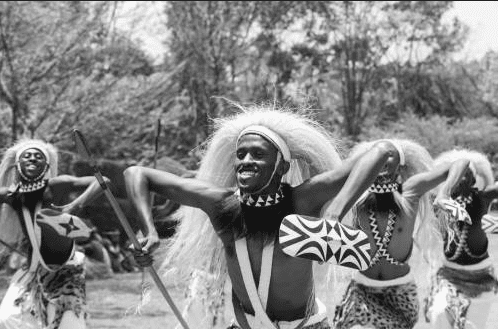
There is a moment, about thirty seconds into an Intore performance, when your body forgets it is watching.
The drums have been building, five, then eight, then twelve players, the rhythm accelerating in layers, and then the dancers enter: tall, barefoot, wearing headdresses of white colobus fur that catch the air as they move, carrying shields and spears that are not props but extensions of the body. They move low and fast across the performance ground in formation, strike the earth with their feet in unison, and the sound that comes back is less like percussion than like a collective human pulse.
Burundian dance traditions are among the most powerful and technically accomplished performance traditions in Africa. And the Intore warriors performance, the most celebrated expression of those traditions, is one of the most extraordinary things you can watch anywhere on the continent.
What Are Burundian Dance Traditions?
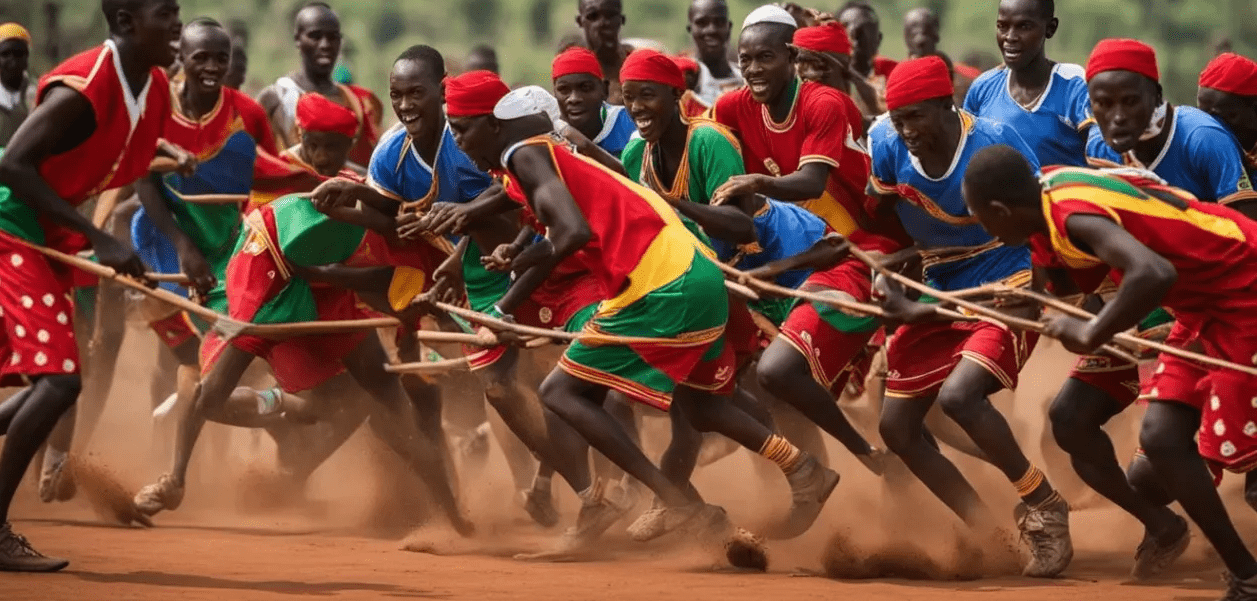
Burundian dance traditions are not a single style but a family of related performance forms. This have evolved over centuries within the social and political structures of the Great Lakes kingdom period. Dance in traditional Burundian culture was never purely entertainment. It was a language, a system of communication that expressed status, spirituality, martial prowess, community cohesion, and the relationships between the living and their ancestors.
The three main categories of traditional Burundian dance are:
Royal court dances, performed by trained specialists at the court of the Mwami (king) and on formal ceremonial occasions. These are the dances from which the Intore tradition primarily descends.
Agricultural and seasonal dances, performed by farming communities to mark planting, harvest, and the key transitions of the agricultural calendar. These are participatory and communal, involving large numbers of people rather than trained specialists.
Initiation and ceremonial dances, performed at life transition events, birth ceremonies, coming-of-age rituals, weddings, and funerals. These carry specific ritual meanings that are contextual rather than performative.
All three categories share foundational characteristics: rhythmic complexity, physical intensity, strong relationship between movement and drumming, and a social function that extends beyond the aesthetic.
The Intore Warriors: History and Meaning
The Intore, the name translates approximately as “the chosen ones” or “the best”, were historically an elite corps of warriors trained at the royal court of the Mwami. Their dance was not a celebration of war for its own sake but a display of the qualities, courage, discipline, physical excellence, coordination, that defined the ideal Burundian warrior and, by extension, the ideal Burundian man.
Training as an Intore dancer was a mark of distinction. Young men selected for the corps underwent years of intensive physical and performance training, developing the extraordinary combination of strength, agility. The rhythmic precision that the dance requires. Mastery of the Intore form was a path to social advancement, a trained Intore dancer had status at the royal court and in the community.
The aesthetic vocabulary of the Intore performance reflects this martial origin. The white colobus fur headdress, the most recognisable element of the costume, historically signalled the dancer’s elite status. The shield and spear carried during the performance are functional objects given ceremonial significance. The formations, advancing lines, rotating groups, solo displays of athletic virtuosity, echo military manoeuvre while transforming it into art.
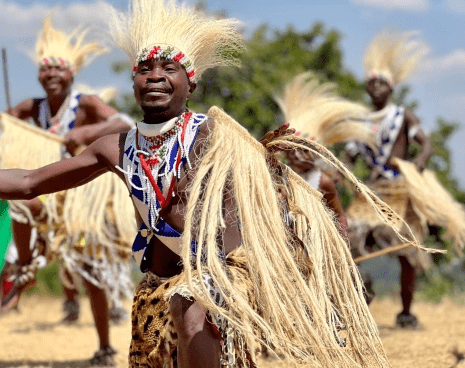
What makes the Intore tradition particularly significant in the context of Burundian dance traditions is its survival. The royal court that originally sustained it was dissolved with independence in 1966. The tradition did not disappear. It was maintained by community groups, cultural associations, and, crucially, by the Gitega school of traditional performance. This has trained Intore dancers continuously for decades and which remains the primary institutional guardian of the form.
The Performance: What to Expect
An Intore performance typically runs 45 minutes to an hour and follows a structured programme that moves from formal opening to individual virtuoso displays to collective climax.
The opening: Drummers enter and establish the foundational rhythm. The interplay between the lead drummer and the ensemble is itself a performance, a conversation in percussion that the experienced ear can follow as narrative. The Burundian royal drum tradition, separately recognised by UNESCO, is the sonic foundation on which all Intore performance rests.
The entry of the dancers: The Intore enter in formation, moving in perfect synchrony. The initial sequences are collective, the group demonstrating its unity before the individual voices emerge.
Solo displays: Individual dancers break from the group to perform extended solo sequences showcasing specific technical skills, high kicks, The rapid footwork, dramatic spear movements, the controlled use of the headdress as a visual element. These solos are competitive in spirit; the group watches and responds, and the best performers are acknowledged with shouts and increased drumming intensity.
The climax: The full group reunites for a final collective sequence of accelerating intensity. The drumming builds, the movement accelerates, and the performance ends at a peak of collective energy that leaves audiences, local and international alike, in a state of genuine electrification.
Where to See Intore Performances in Burundi
Gitega Cultural Centre: The most reliable venue for witnessing authentic Intore performances in a cultural context. Gitega is the home of Burundi’s royal drumming and dance tradition and hosts regular performances at the national cultural centre.
National Museum of Gitega: Performances are sometimes organised for visiting groups in the museum’s outdoor performance space, a particularly atmospheric setting with the museum’s historical exhibits as backdrop.
Umuganuro Festival: The annual sorghum festival, held in September or October in Gitega, is the largest and most elaborate context for traditional Burundian dance traditions and includes Intore performances as a central element.
Bujumbura hotels and cultural centres: Several upmarket hotels in Bujumbura organise cultural performance evenings that include Intore elements alongside other Burundian performance traditions. These are accessible and convenient, though they lack the cultural depth of a Gitega performance.
On request through specialist operators: Feather Trail Safaris can arrange private Intore performances at cultural venues as part of a customised Burundi cultural tour, the most intimate and highest-quality way to experience the tradition.
Burundian Dance Traditions in the Modern Context
The relationship between traditional performance and contemporary culture in Burundi is complex and generative. Young Burundians are not uniformly enthusiastic about traditional dance forms. Others see them as markers of a past that modern life has moved beyond. But among the community of practising performers and cultural practitioners, there is a strong and articulate sense that the Intore tradition is not a museum piece but a living art form capable of evolution.
Contemporary Burundian choreographers are working with Intore vocabulary. This is aimed at creating new performance forms that maintain the technical foundation while engaging with contemporary themes. These hybrid performances, seen at cultural festivals and in Bujumbura’s growing arts scene, represent the tradition’s most vital current expression: neither frozen in historical amber nor abandoned for modernity, but genuinely alive in the present.
Travel Tips for Experiencing Burundian Dance Traditions
Book through a cultural specialist. Generic tour operators may offer “cultural shows” that are abbreviated and decontextualised. A specialist operator with genuine cultural contacts can access authentic performance contexts.
Learn some history first. The National Museum of Gitega and several good introductory books on Great Lakes cultural history provide context that makes the performance significantly more resonant.
Tip the performers. A tip of $5 to $10 per visitor for a private performance is standard and appropriate. For large public performances, buying a cultural souvenir from associated vendors achieves a similar purpose.
Attend the Umuganuro if your timing allows. The September/October Umuganuro festival is the single best context for experiencing the full range of Burundian dance traditions in their natural social environment.
FAQs
What is the most famous Burundian dance tradition?
The Intore warriors performance is the most internationally recognised. The royal drum tradition, which underlies all Intore performance. This is separately recognised by UNESCO as an Intangible Cultural Heritage of Humanity.
Can tourists participate in Burundian dance?
At community-level performances and some cultural festivals, visitor participation in simpler agricultural and seasonal dances is warmly invited. Intore performance requires years of specialist training and is not a participation activity.
Is it respectful to film Intore performances?
Photography and video of public and formally arranged performances is generally acceptable. Ask permission before filming close-ups of individual performers. At private community ceremonies, follow your guide’s advice.
How long has the Intore tradition existed?
The tradition dates to the period of the Great Lakes kingdoms, at least several centuries. The specific form as it exists today has been shaped. This has transmitted through the royal court tradition and the Gitega cultural school.
Where can I book a Burundian dance traditions experience?
Contact Feather Trail Safaris for a customised cultural itinerary that includes authentic Intore performance in the appropriate Gitega context.
Explore all Burundi cultural tours with Feather Trail Safaris