
Can You Share Costs on a Rwanda Safari?
When the idea of going on safari in Rwanda first takes shape, it usually begins with excitement, images of mist-covered hills, wildlife moving freely across open landscapes, and the unforgettable experience of exploring places like Akagera National Park or trekking through forests near Volcanoes National Park.
But not long after that excitement comes a more practical thought:
“How much is this actually going to cost?”
And then, almost naturally, the next question follows:
“Is there a way to share costs and make this more affordable?”
It’s a smart question and an important one.
Because while Rwanda offers one of the most organized, safe, and high-quality safari experiences in Africa, it is also known for being on the higher end in terms of pricing. That’s not by accident. Rwanda has intentionally positioned itself as a premium destination, focusing on conservation, sustainability, and controlled tourism.
But here’s what many travelers don’t realize at first:
A Rwanda safari doesn’t have to be expensive in the way you might think if you understand how cost-sharing works.
And more importantly, if you understand how to do it well.
This isn’t just about saving money. It’s about structuring your safari in a way that keeps the experience rich, smooth, and memorable, without unnecessary financial pressure.
So let’s walk through this properly, not in a rushed or surface-level way, but in a way that helps you truly understand what sharing costs on a Rwanda safari means.
Why Rwanda Safaris Cost What They Cost
Before you can understand how to reduce costs, you need to understand why they exist in the first place.
A safari in Rwanda is not a simple, independent trip where you move freely from place to place. It’s a structured experience that involves coordination, expertise, and logistics working together.

When you book a safari, you are not just paying for a destination, you are paying for a system.
That system includes:
- A professional safari vehicle (often a 4×4 designed for rough terrain)
- A trained driver-guide who understands wildlife, routes, and safety
- Fuel, which is not insignificant given the terrain
- Park entry fees and conservation charges
- Accommodation near protected areas
- Coordination of activities and timing
And in some cases, especially for primate tracking, permits managed by institutions like the Rwanda Development Board.
All of these elements are essential. They are not optional add-ons.
And this is exactly why cost-sharing becomes so powerful, because many of these costs are fixed, regardless of how many people are involved.
Understanding the Core Idea of Cost Sharing
At its simplest, cost-sharing means dividing fixed expenses among multiple travelers.
But in practice, it’s more than just splitting a bill.
It’s about recognizing that certain parts of your safari cost the same whether you are alone or with others.
Take a safari vehicle, for example.
Whether one person is in that vehicle or four people are in it, the cost of:
- Hiring the vehicle
- Paying the driver-guide
- Fueling the journey
So when you share that vehicle, the cost per person drops significantly—without changing the actual experience.
This is the foundation of cost-sharing.
And once you understand it, you begin to see how a Rwanda safari becomes far more accessible.
Transport: The Single Biggest Opportunity to Save
If there is one area where cost-sharing makes the biggest difference, it is transport.
I remember looking at the cost of a private safari vehicle for the first time and thinking, “This is where most of the budget goes.”
And that’s true.
But then I realized something equally important:
That cost is not meant to be carried by one person alone.
When you share a vehicle:
- Two people split the cost in half
- Three or four people reduce it even further
And yet, the experience remains unchanged.
You are still:
- Traveling in the same comfortable 4×4
- Guided by the same knowledgeable driver
- Exploring the same landscapes
The only difference is how the cost is distributed.
And interestingly, sharing transport often adds something unexpected to the journey—conversation, shared anticipation, and moments that feel more human.
Accommodation: Sharing Space Without Losing Comfort
Accommodation is another area where cost-sharing works naturally.
Most lodges in Rwanda, especially around key destinations, are designed for shared occupancy. Whether it’s a double room or a twin setup, the pricing is structured in a way that encourages sharing.
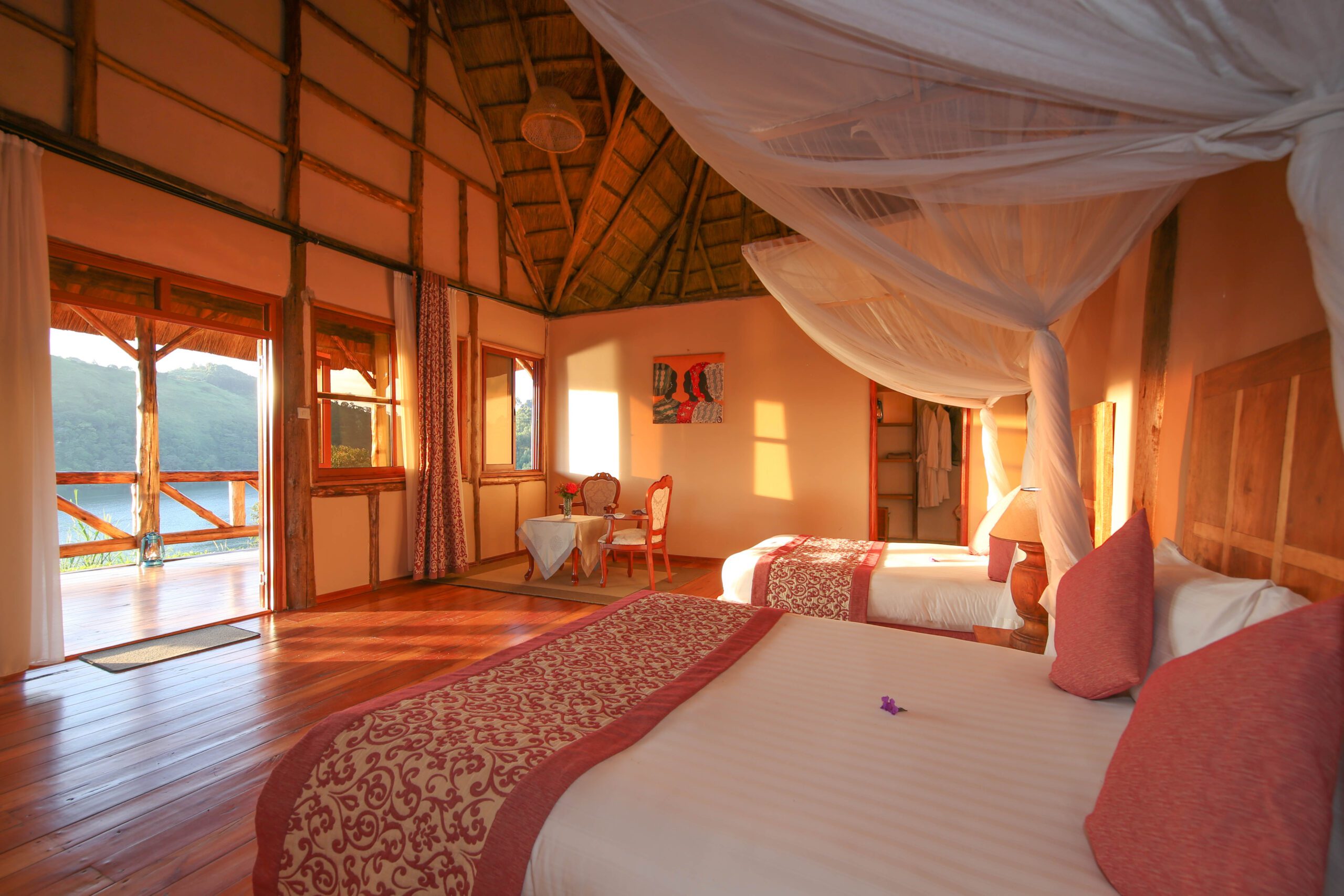
When two people share a room:
- The cost per person drops significantly
- The overall comfort remains the same
And unlike what some might assume, this doesn’t feel like a compromise.
After a long day exploring Akagera National Park or preparing for an early start near Volcanoes National Park, what matters most is having a comfortable place to rest.
Sharing simply makes that more efficient.
Activities: Where Sharing Works, and Where It Doesn’t
This is where things require a bit more clarity.
Not all safari costs can be shared.
Activities That Can Be Shared
- Game drives in Akagera National Park
- Boat safaris
- Guided tours
- Transfers between destinations
These are flexible, group-friendly experiences.
Sharing them reduces cost without affecting quality.
Activities That Cannot Be Shared
- Gorilla trekking permits in Volcanoes National Park
- Chimpanzee tracking permits in Nyungwe Forest National Park
These are strictly individual.
Each person must have their own permit, and the cost remains fixed.
This is one of the most important distinctions to understand.
Cost-sharing reduces many expenses, but it does not eliminate all of them.
Traveling as a Group vs Joining a Group
There are two main ways to share costs, and each offers a slightly different experience.
Traveling with People You Know
This is often the most straightforward option.
You plan together, agree on preferences, and share costs naturally.
There is comfort in familiarity and ease in decision-making.
Joining a Group Safari
This option opens the door to meeting new people.
At first, it may feel uncertain, but many travelers find that sharing a journey with others adds unexpected richness.
You exchange stories, perspectives, and experiences.
And in many cases, those connections become part of what you remember most.
Finding the Right Balance
While sharing costs is beneficial, it’s important to approach it thoughtfully.
Too much sharing, especially in terms of group size, can start to affect comfort.
For example:
- A small group feels flexible and relaxed
- A large group may feel restrictive
The goal is not to maximize savings at all costs.
The goal is to find a balance where:
- Costs are reduced
- Comfort is maintained
- The experience remains enjoyable
The Hidden Value of Sharing
Beyond the financial aspect, there is something else that cost-sharing offers.
It brings people together.
A safari is not just about wildlife or landscapes, it’s about moments.
Moments of:
- Watching the horizon in silence
- Reacting to a sighting together
- Sharing stories at the end of the day
When you share costs, you often end up sharing experiences in a deeper way.
Working with the Right Operator Makes All the Difference
Cost-sharing doesn’t happen automatically, it requires coordination.
Aligning schedules, matching travelers, planning routes, it all needs to be done carefully.
This is where working with an experienced operator becomes essential.
A professional team ensures that:
- Group sizes are appropriate
- Itineraries are aligned
- The experience remains smooth
Without that coordination, what should be simple can become complicated.
Lastly: Sharing Costs Without Losing the Experience
So, can you share costs on a Rwanda safari?
Yes and not only can you, but you should consider it if you want to make the experience more accessible.
But the real insight is this:
Sharing costs is not about reducing the value of your safari, it’s about redistributing it in a smarter way.
You still experience:
- The same landscapes
- The same wildlife
- The same unforgettable moments
What changes is how you get there, and how much you spend getting there.
Plan Your Rwanda Safari with Feather Trail Safaris
At Feather Trail Safaris, we understand that every traveler has a different approach to planning.
Whether you want to share costs, travel privately, or find the perfect balance, we help design safaris that align with your budget while preserving the experience. Because a safari in Rwanda should not feel out of reach, it should feel possible, meaningful, and truly worth it.
FAQ
Can you share a safari vehicle in Rwanda?
Yes, travelers can share safari vehicles to split transport costs and reduce overall expenses.
Can gorilla trekking costs be shared?
No, gorilla permits are issued per person and cannot be shared.
Is sharing a safari worth it?
Yes, it significantly reduces costs while maintaining the same experience.
Talk to a Safari Expert!