
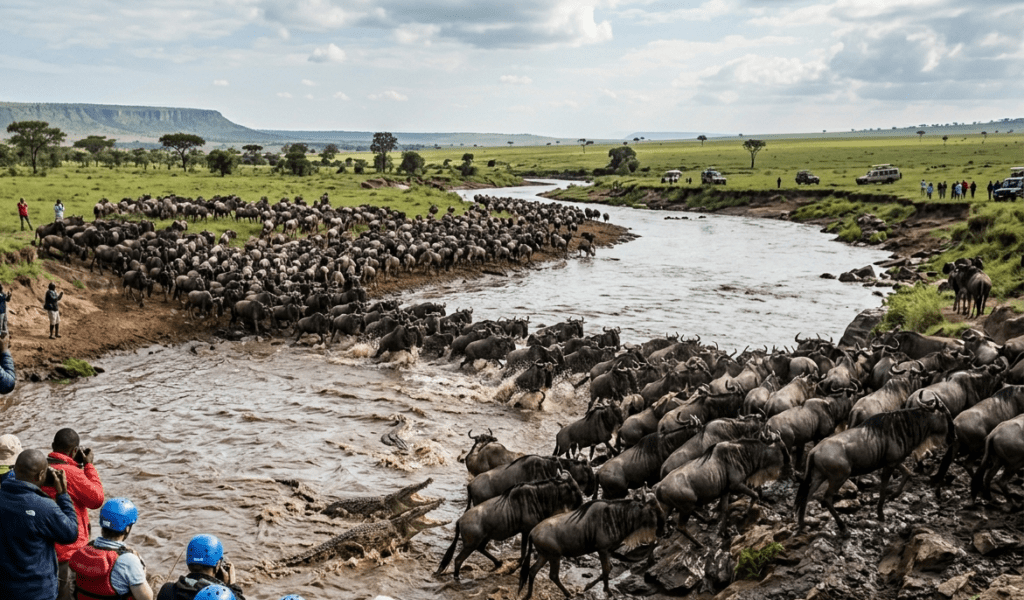
Witness the Great Migration: A Once-in-a-Lifetime Safari Experience in East Africa
There are moments in travel that stay with you forever moments that are not just seen, but deeply felt. Witnessing the Great Migration across Kenya and Tanzania is one of those rare experiences. It is not simply a safari. It is nature in its most raw, powerful, and breathtaking form.
This is the story of what it truly feels like to be there.
The Early Morning Silence Before the Adventure
The day begins before sunrise. The air is cool, almost still, with only the faint sounds of nocturnal life fading into the distance. A safari vehicle waits outside, engine softly humming, as the first light of dawn begins to stretch across the horizon.
There is a sense of anticipation among travelers quiet excitement mixed with curiosity. No one speaks much. Everyone knows something extraordinary awaits, though no one can fully predict what the day will reveal.
As the vehicle rolls forward into the open plains, the landscape slowly comes alive. Golden grasses shimmer under the rising sun. Acacia trees cast long shadows. And in the distance, movement begins to appear.
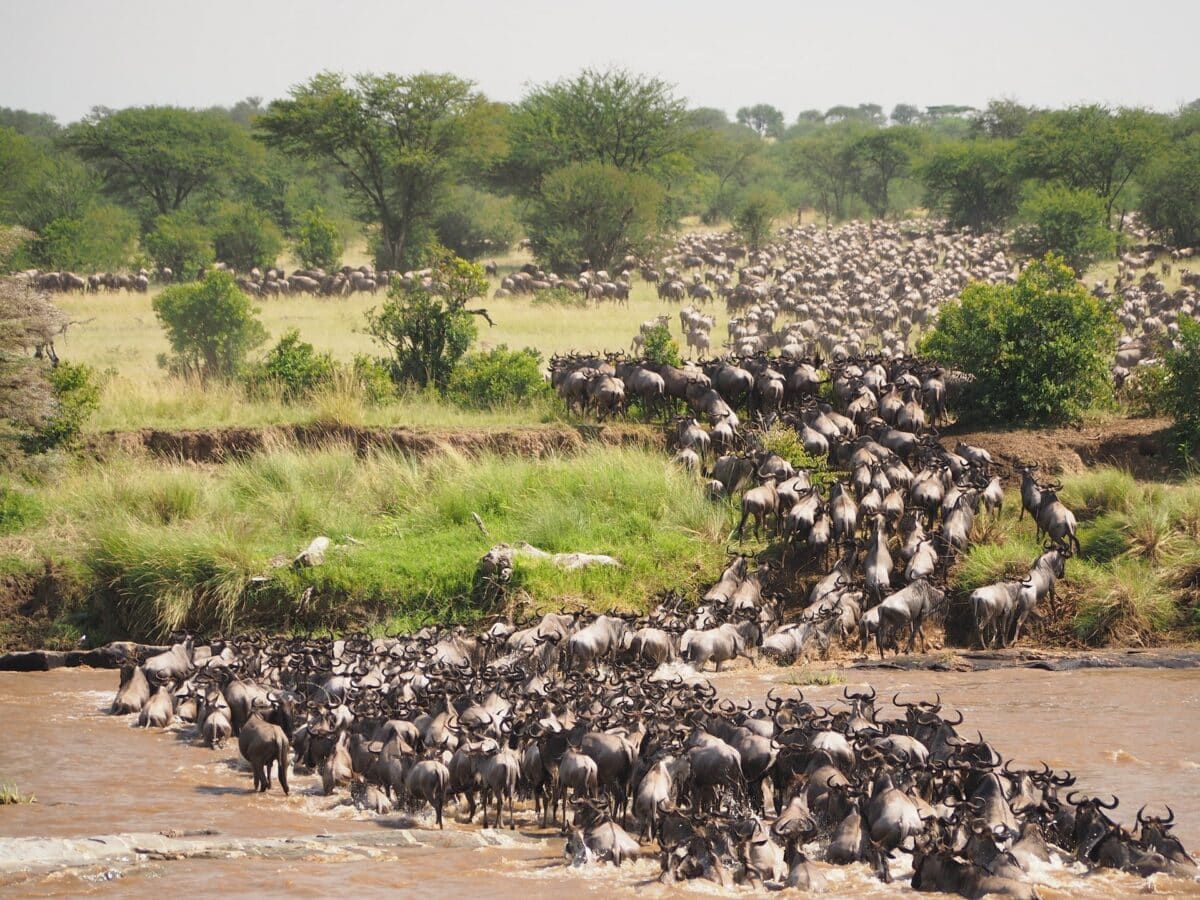
Not just a few animals but thousands.
Entering the World of the Migration
The Great Migration is not a single event. It is a continuous, cyclical movement of over a million wildebeest, accompanied by hundreds of thousands of zebras and gazelles, traveling across the vast ecosystems of East Africa in search of fresh grazing and water.
As the vehicle approaches the herds, the scale becomes overwhelming.
At first, it looks like the land itself is moving.
Then you realize, it is alive.
Endless lines of wildebeest stretch across the plains. Zebras graze alongside them, their stripes blending into the horizon. The air carries the sounds of low grunts, calls, and the occasional alarm snort.
It is a living river of animals, flowing across the earth.
And you are standing at the edge of it.
The Rhythm of Survival
The migration is not just beautiful, it is a story of survival. Every step, every pause, every crossing is driven by instinct and necessity.
Predators follow closely behind.
Lions rest in the shade, observing. Cheetahs scan the horizon from small elevations. Hyenas move silently through the grass, always alert. And beneath the surface of the rivers lie crocodiles, waiting patiently for the moment when the herds arrive.
Nothing in this ecosystem happens by chance.
Every animal plays its role and moment carries tension.
Every movement matters.
The Mara River Crossing: Nature’s Most Dramatic Stage
One of the most unforgettable moments of the Great Migration is the river crossing. It is here that the true intensity of nature reveals itself.
You arrive at the riverbank after hours of tracking the herds. The atmosphere changes immediately. The animals gather near the edge, hesitant, restless.
There is no clear signal. No guide. No leader giving instructions.
Just instinct.
The wildebeest stand in clusters, shifting nervously. Some pace back and forth. Others stare across the river, as if calculating the risks. The water below moves swiftly, dark and unpredictable.
Time seems to slow.
Then suddenly movement.
One wildebeest steps forward.
Another follows.
And within moments, the entire herd erupts into action.
Chaos, Courage, and Survival
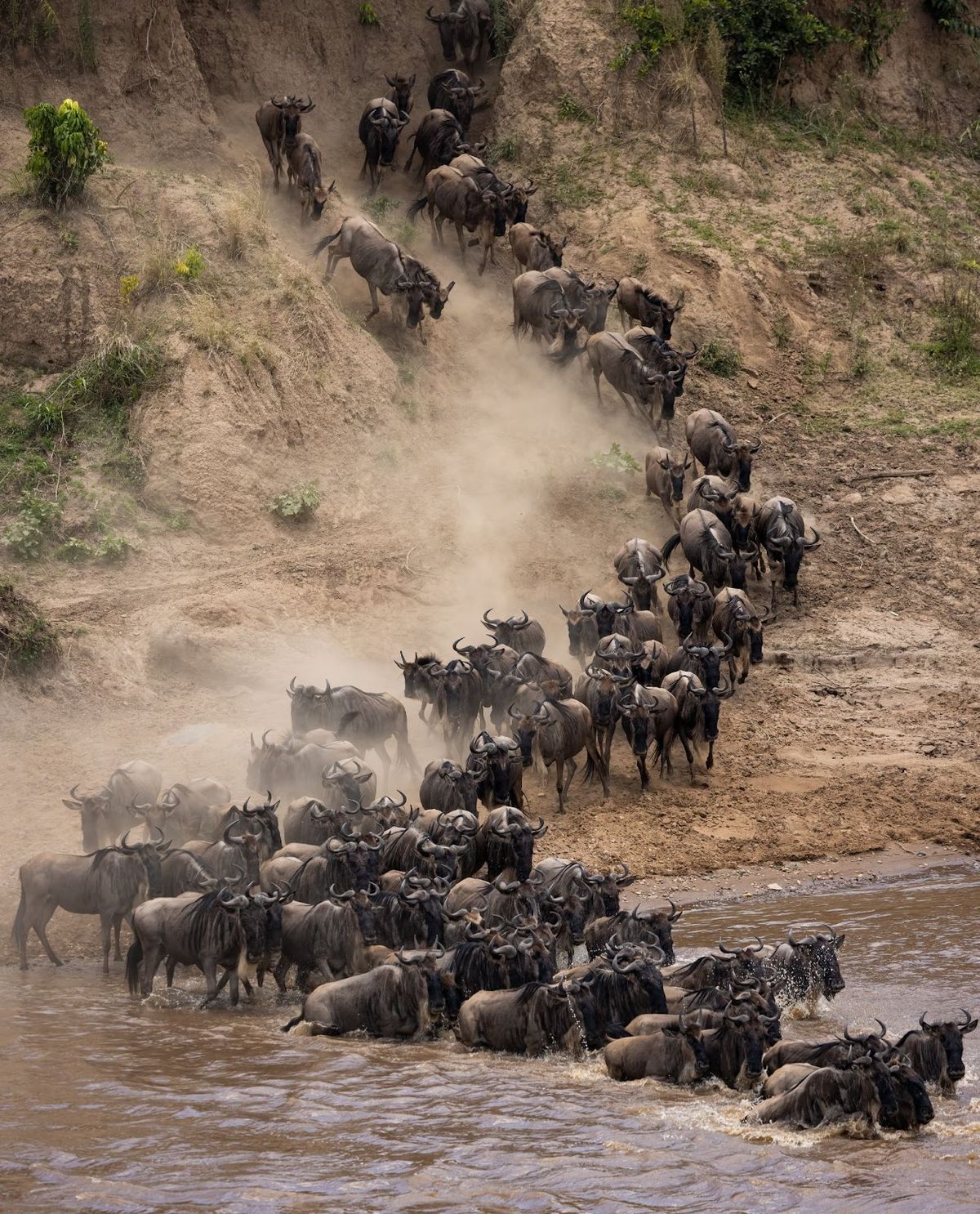
The crossing begins with a surge of energy. Hooves pound the ground. Dust rises into the air. The herd pushes forward as one, leaping into the river.
The water churns violently as hundreds of bodies enter at once. Some struggle against the current. Others climb over rocks and each other in a desperate attempt to reach the opposite bank.
The tension is palpable.
Crocodiles lie beneath the surface, barely visible until the moment they strike. Predators take advantage of hesitation, targeting the weakest or the slowest.
It is not easy to watch.
It is not meant to be.
This is nature in its purest form, unfiltered, unforgiving, and incredibly real.
Yet amidst the chaos, there is also resilience.
Many make it across. Some do not.
And those that do continue their journey, driven forward by something deeper than fear.
The Emotional Impact of Being There
Standing at the riverbank or watching from a nearby vantage point, travelers often experience a mix of emotions.
Awe.
Respect.
Silence.
There are no distractions here. No artificial sounds. No screens. Just the rhythm of nature unfolding in front of your eyes.
Many describe the experience as humbling.
It reminds you of the scale of the natural world, and your place within it.
This is not entertainment, not staged. It is real life, happening in real time.
Beyond the River: Life on the Plains
While the river crossings often steal the spotlight, the broader migration experience is equally remarkable.
On the open plains, the herds spread out in massive numbers, grazing continuously. Calves stay close to their mothers, learning to navigate the world around them. Young zebras move in tight groups, protected by the collective strength of the herd.
Birds follow the migration as well, feeding on insects stirred up by the movement of animals.
In the distance, predators watch patiently, waiting for opportunity.

Life here is constant motion.
There is no pause.
No pause for rest.
No pause for survival.
A Day in the Life of a Migration Safari
A typical day begins early and unfolds gradually:
- Early morning game drives to catch active wildlife
- Midday rest as animals seek shade
- Afternoon tracking as movement increases
- Evening drives when predators become more active
Each part of the day offers something unique.
Sometimes the highlight is not a dramatic crossing, but a quiet moment—like watching a lion pride resting after a hunt, or seeing elephants moving slowly across the horizon.
Every drive brings new surprises.
No two days are ever the same.
Why the Great Migration is So Special
What makes the Great Migration truly unique is not just the number of animals, but the scale of natural coordination.
There is no map guiding the herds.
No leader directing the route.
Only instinct shaped by generations of survival.
The movement follows rainfall patterns, grazing conditions, and seasonal cycles that have existed for centuries.
It is one of the last remaining large-scale wildlife migrations on Earth.
And witnessing it firsthand is something few experiences can match.
The Role of Expert Safari Guides
A great safari experience is not just about being in the right place, it is about understanding what you are seeing.
Experienced guides play a crucial role in interpreting animal behavior, predicting movements, and positioning vehicles at the best possible vantage points.
They read the land, track signs, and anticipate the next steps of the migration.
Their knowledge transforms the experience from simple observation into a deeper understanding of the ecosystem.
With the right guide, every moment becomes more meaningful.
Responsible Tourism and Conservation
Experiencing the Great Migration also comes with responsibility.
Tourism plays an important role in supporting conservation efforts, protecting wildlife habitats, and supporting local communities.
Responsible safari practices ensure that:
- Wildlife is not disturbed
- Ecosystems remain balanced
- Local communities benefit from tourism
- Natural resources are preserved for future generations
By choosing ethical safari operators, travelers contribute directly to the protection of these incredible environments.
Who Should Experience the Great Migration?
The Great Migration is suitable for:
- Wildlife enthusiasts
- Photographers
- Adventure travelers
- Honeymooners seeking unique experiences
- Families looking for educational trips
- Anyone seeking a once-in-a-lifetime journey
It is not just for experienced travelers. Even first-time safari visitors find it accessible, comfortable, and unforgettable.
Planning the Perfect Migration Safari
Timing is one of the most important factors when planning a migration safari.
- Mid-year months are ideal for river crossings
- Earlier months offer calving and predator interactions
- Different regions provide different stages of the migration
Accommodations range from luxury lodges to mobile camps that move with the herds, ensuring proximity to the action.
A well-planned itinerary increases your chances of witnessing key moments of the migration while also allowing time to enjoy other wildlife experiences.
What Travelers Often Say After Experiencing It
Many travelers leave with similar reflections:
- “It felt like stepping into a documentary.”
- “I didn’t expect it to be this intense.”
- “It changed the way I see wildlife.”
- “It was more emotional than I imagined.”
The Great Migration is not just visually impressive—it is emotionally powerful.
It leaves a lasting impression that goes beyond photographs and videos.
A Journey That Stays With You Forever
As the day ends and the safari vehicle returns to camp, the sun begins to set over the plains. The sky turns shades of orange, pink, and purple. The herds continue moving in the distance, their silhouettes fading into the horizon.
There is a quiet moment of reflection.
What you have witnessed is not just a safari highlight, it is one of the greatest natural spectacles on Earth.
And now, you carry that memory with you.
Not as a story told by others, but as an experience you lived.
Ready to Witness the Great Migration?
The Great Migration is more than a destination it is an experience that connects you deeply with nature, adventure, and the raw beauty of life in the wild.
If you have ever dreamed of witnessing something truly extraordinary, this is it.
A journey where every moment matters.
A landscape that tells its own story.
And an experience that stays with you long after you return home. Book with Feather Trail Safaris!